
The 2026 release of SketchUp Pro brings a fresh set of capabilities to the world of three‑dimensional design, catering to professionals who demand precision without sacrificing speed. Built on a mature engine, this version refines the workflow that architects, engineers, and product designers have relied on for years, while adding modern touches that keep the platform competitive in today’s fast‑moving market.
Whether you are sketching early concepts or preparing construction‑ready documentation, the suite offers a balanced mix of simplicity and depth. Its portable nature means you can run the program from external storage without a full installation, yet the core experience mirrors the full desktop edition, ensuring consistency across work environments.
User‑Friendly Interface
The toolbar is organized around a clean visual hierarchy, placing the most frequently used commands at the leftmost edge for instant access. Icons are crisp and labeled, reducing the learning curve for newcomers while preserving efficiency for seasoned users.
Context‑sensitive menus appear as you hover over geometry, presenting relevant actions such as extrude, rotate, or apply a material. This dynamic feedback eliminates the need to dig through nested dialogs, allowing designers to stay focused on the model rather than the software.
Core Modeling Tools
Fundamental drawing primitives—including lines, rectangles, circles, and polygons—form the backbone of every project. Each primitive snaps to a robust grid system, ensuring alignment and precision across complex assemblies.
Beyond the basics, the suite offers push‑pull extrusion, follow‑me path creation, and solid modeling operations such as union, subtract, and intersect. These tools enable users to transition from flat sketches to fully realized volumetric objects with just a few clicks.
Advanced Materials & Texturing
A library of pre‑configured textures and finishes accelerates the visual development of interiors and facades. Materials are organized by category, making it simple to locate concrete, glass, wood, or metal presets.
For projects that demand a unique look, the editor supports custom material creation, allowing you to import bitmap images, adjust reflectivity, and define bump maps. These settings are stored with the model, guaranteeing that collaborators see the same visual intent.
Documentation and Presentation Features
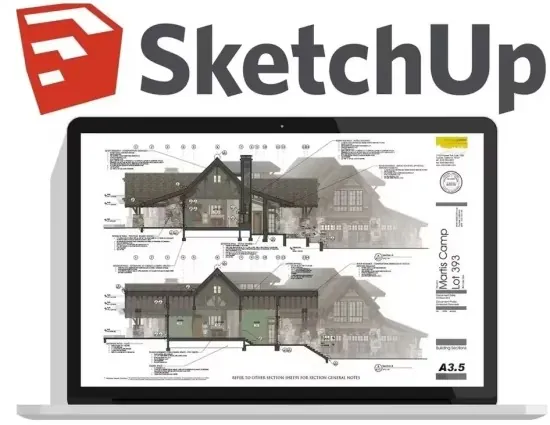
The integrated layout environment transforms 3D geometry into precise 2D drawings, ideal for construction packages and client presentations. You can generate floor plans, sections, and elevations directly from the model, preserving scale and annotation fidelity.
- Scaled 2D layout generation for accurate plan sets
- Automatic dimensioning tools that update with model changes
- Custom annotation styles for notes, tags, and callouts
- Export options including PDF, DWG, and high‑resolution images
Layout sheets can be organized into multi‑page documents, and each sheet supports viewports that stay linked to the underlying 3D model. This live connection means revisions propagate instantly, reducing the risk of outdated documentation.
Collaboration and Cloud Integration
Projects are stored in Trimble Connect, a cloud‑based hub that facilitates real‑time sharing and version control. Team members can comment directly on geometry, attach reference files, and track change history without leaving the application.
The platform also supports export to common formats for downstream workflows, such as BIM tools or rendering engines. By centralizing assets and communications, the suite helps reduce miscommunication and accelerates the path from concept to construction.