
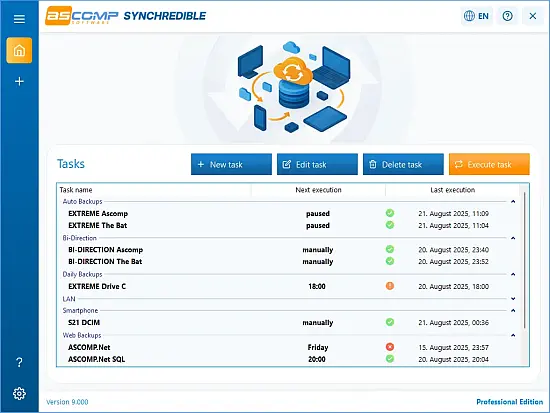
In today’s fast‑paced digital workplaces, keeping files consistent across laptops, desktops, external drives and network shares is a daily challenge. A reliable synchronization utility can eliminate manual copying, reduce version‑control errors, and protect critical data from accidental loss. The application under review delivers exactly that, offering a seamless bridge between multiple storage locations while preserving folder structures and timestamps.
Because it runs directly from any folder without a traditional installation, the tool is especially handy for consultants, field engineers and anyone who needs a ready‑to‑use sync engine on different machines. Its lightweight footprint and multilingual interface make it accessible to a global audience while still providing enterprise‑grade features.
Real‑time Change Detection
The core engine continuously monitors source directories for modifications, renames, deletions or attribute changes. As soon as a change is detected, the program mirrors the update to every linked destination, guaranteeing that each device holds the latest version of every file. This instantaneous propagation removes the guesswork of manual backups and ensures that collaborators always work with current data.
When conflicting edits arise—such as two users altering the same file simultaneously—the solution applies a clear set of rules. Users can prioritize the newest timestamp, preserve both versions in separate folders, or receive a prompt to decide manually. This conflict‑resolution framework prevents accidental overwrites and maintains data integrity across all synchronized locations.
Flexible Scheduling and Filters
Beyond on‑demand syncing, the utility supports a rich schedule matrix. Administrators can define one‑time runs, recurring intervals measured in minutes or hours, and specific execution windows tied to calendar days or times of day. Additional triggers allow synchronization to start automatically when Windows boots, when a user logs off, or after a predefined idle period, providing hands‑free operation for routine tasks.
- Include only selected file extensions to narrow the sync scope
- Exclude system, temporary or hidden files that do not need replication
- Apply size thresholds so that very large files are synced only on high‑bandwidth connections
- Utilize archive‑bit settings to sync only files marked for backup
- Restrict synchronization to particular subfolders for granular control
These filter options can be combined with the scheduling engine to craft highly targeted sync jobs. For example, a nightly job might copy only newly created documents from a project folder while ignoring unchanged media files, dramatically reducing network traffic and storage overhead.
Cross‑Platform and Multi‑Language Support
The program runs natively on Windows, macOS and major Linux distributions, allowing mixed‑OS teams to share a single synchronization standard. File permissions, symbolic links and case‑sensitive paths are handled according to the conventions of each operating system, ensuring that the same job behaves predictably regardless of the host platform.
A fully localized user interface is available in dozens of languages, from English and German to Japanese and Arabic. This multilingual support reduces the learning curve for non‑technical staff and promotes consistent usage across international offices, while the underlying engine remains language‑agnostic.
Performance Optimizations
To keep synchronization fast, the software offers optional on‑the‑fly compression, which shrinks data packets before they traverse the network or USB bus. Coupled with hardware‑accelerated CRC32 checksums (leveraging SSE4.2 when available), integrity verification is performed with minimal CPU impact, allowing large batches of files to be processed in seconds.
An intelligent change‑analysis algorithm scans file metadata and content hashes to decide whether a file truly needs copying. Unmodified files are automatically skipped, and buffer sizes can be tuned to match the capabilities of the storage medium, further reducing I/O bottlenecks and improving overall throughput.
Advanced Automation and Safety Features
Power users can launch synchronization jobs via command‑line parameters, embed them in batch scripts, or attach them to Windows Task Scheduler for precise control. A preview mode lists every pending operation before any data moves, giving administrators a safety net to verify actions in advance.
When deletions are propagated, the tool can move the removed items to the Recycle Bin instead of erasing them outright, providing an extra recovery layer. Detailed logs, CRC32 verification reports and optional email notifications round out a comprehensive audit trail, making the solution suitable for regulated environments where traceability is mandatory.