
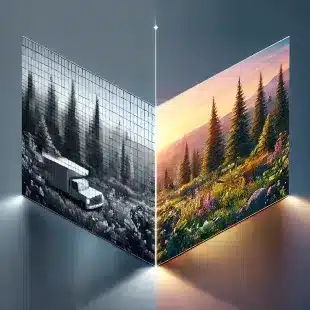
Low‑resolution images and video clips often act as bottlenecks for creators who want to repurpose legacy material for modern platforms. Scale Photo Up 2.0.17 tackles this problem by applying a deep‑learning model that can double the pixel count while preserving—or even enhancing—visual fidelity. The tool runs locally, which means sensitive personal archives never leave your computer, and it supports both stills and moving pictures. By reconstructing missing information rather than simply stretching existing pixels, the software delivers results that look natural and detailed, turning grainy memories into crisp assets ready for any audience.
Beyond the visual upgrade, Scale Photo Up 2.0.17 offers a workflow that does not rely on cloud services, ensuring privacy and eliminating bandwidth constraints. The program detects compatible NVIDIA GPUs and leverages CUDA cores to accelerate the upscaling pipeline, cutting processing time dramatically compared with CPU‑only execution. When a suitable graphics card is absent, the application gracefully falls back to the processor, though users should expect longer render cycles. This dual‑mode design makes the software accessible to a wide range of hardware configurations while still delivering professional‑grade output for both hobbyists and commercial studios.
AI‑Driven Upscaling Engine
The core of Scale Photo Up 2.0.17 is a convolutional neural network specifically trained on millions of high‑resolution samples. During inference, the model analyses each input frame, predicts the most plausible high‑frequency details, and injects them into the upscaled output. This approach differs from traditional interpolation because it learns contextual cues such as edges, textures, and lighting gradients, allowing it to fill gaps with plausible information rather than generic blur. As a result, the final image exhibits sharper contours, richer color transitions, and a level of detail that would be impossible to achieve with naïve scaling algorithms.
Training data for the engine includes a diverse mix of natural scenes, urban environments, and synthetic graphics, which helps the network generalize across a broad spectrum of content. Noise reduction is baked into the process; the model simultaneously denoises while upscaling, suppressing grain without sacrificing fine structures. Edge preservation is further reinforced by a dedicated loss function that penalizes halo artifacts, ensuring that borders remain crisp. The combination of these techniques yields an output that feels both clean and authentic, making the upscaled media suitable for professional publishing or personal archiving.
Performance and Hardware Guidance
To achieve real‑time or near‑real‑time results, Scale Photo Up 2.0.17 recommends an NVIDIA GPU with at least 4 GB of VRAM. When such hardware is present, the application dispatches the neural inference to the GPU, exploiting parallel processing to handle thousands of pixels per millisecond. Benchmarks show that a mid‑range RTX 2060 can upscale a 1080p video to 4K in roughly half the time required by a high‑end CPU core. Users can monitor GPU utilization within the interface, allowing them to balance speed against power consumption based on project deadlines.
If a compatible GPU is unavailable, the software automatically switches to CPU mode, which still produces identical visual results but at a slower pace. In this scenario, allocating sufficient RAM—ideally 8 GB or more—is crucial to prevent paging and maintain stability during batch operations. The program also offers a configurable thread count, enabling users to match processing intensity to the number of logical cores. While CPU‑only rendering may extend processing times by a factor of three to five, it remains a viable option for laptops or workstations lacking dedicated graphics.
Creative Scenarios and Benefits
Content creators quickly discover that the upscaling capabilities open doors to projects that were previously impractical due to resolution limits. Whether the goal is to preserve family heritage or to generate eye‑catching marketing assets, the tool adapts to a variety of contexts. Below are some of the most common applications where Scale Photo Up 2.0.17 adds tangible value:
- Revitalize archival family photos and home videos for modern displays.
- Upgrade vintage film clips to 4K or 8K for streaming platforms.
- Enhance low‑resolution social‑media clips before reposting or remixing.
- Produce high‑quality thumbnails and B‑roll that stand out in crowded feeds.
- Prepare polished visual assets for corporate presentations and e‑learning modules.
By integrating these workflows, creators can extend the lifespan of legacy media while meeting the expectations of today’s high‑definition audiences. The AI‑driven process maintains the original artistic intent, avoiding over‑sharpening or artificial artifacts that could detract from authenticity. Consequently, the upscaled output not only looks better but also retains the emotional resonance of the source material, making it suitable for both commercial distribution and personal sharing.
Typical Workflow in Scale Photo Up
Using Scale Photo Up 2.0.17 begins with a straightforward import step; users drag‑and‑drop files into the main window or browse via the built‑in file selector. Once loaded, the interface presents a preview pane where the 2× upscaling factor can be toggled, allowing instant visual comparison between the original and the enhanced version. Additional settings, such as noise reduction strength and edge preservation, are exposed through sliders, giving fine‑grained control without overwhelming novices.
For larger projects, the batch processor lets users queue dozens of files and apply uniform parameters across the set. Export options include lossless PNG for stills and high‑bitrate MP4 for video, with automatic naming conventions to keep files organized. The software also writes metadata tags that record the upscaling method, facilitating downstream asset management. Upon completion, a concise log summarises processing time and any warnings, ensuring that users can verify results before publishing.
Preparing for Future Display Standards
As 4K and 8K displays become commonplace on consumer televisions, smartphones, and VR headsets, low‑resolution archives risk becoming obsolete. Scale Photo Up 2.0.17 equips creators with a proactive solution, allowing them to future‑proof their libraries by converting older material to resolutions that match emerging hardware capabilities. This preemptive approach reduces the need for costly reshoots or re‑recordings, especially for content that cannot be recreated, such as historic events or one‑time performances.
The underlying AI model continues to evolve, and the portable architecture of Scale Photo Up 2.0.17 means that future updates can be applied without re‑installing a full suite. By maintaining a local, GPU‑accelerated pipeline, the software stays resilient against changing cloud policies and bandwidth limitations. Ultimately, the combination of high‑quality upscaling, flexible workflow, and forward‑looking design makes the tool a strategic investment for anyone who values long‑term visual fidelity.