
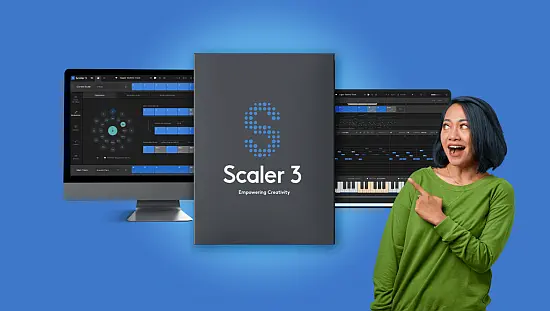
Scaler 3 Standalone v3.3.0 reimagines the way creators approach harmony by merging intelligent analysis with a fully fledged composition environment. The software listens to incoming MIDI or audio, instantly identifies the tonal centre, and proposes chords that naturally fit the detected scale. This instant feedback eliminates the guesswork that often hampers the creative flow, allowing musicians of any skill level to experiment confidently. Whether you are sketching a pop hook, crafting a jazz progression, or designing a cinematic texture, the platform provides a reliable harmonic foundation from the first note.
Since its first release, the product has evolved from a simple key‑finder into a comprehensive harmonic workstation. Early versions supplied basic chord suggestions, while subsequent updates introduced richer libraries, modulation utilities, and tighter DAW integration. The 2025 launch of version 3.3.0 marks a full redesign, adding a multi‑lane timeline, native plugin hosting, and a standalone mode that removes the necessity of a host DAW. These advancements transform the tool from a theory aid into a versatile sketchpad capable of generating complete arrangements without leaving the application.
Smart Harmonic Detection
The core engine continuously monitors incoming signals, applying pitch‑class analysis to pinpoint the prevailing key and scale within milliseconds. Whether the source is a live MIDI keyboard, a pre‑recorded MIDI clip, or an audio loop, the algorithm extracts tonal information and aligns it with an internal database of harmonic rules. This process runs in real‑time, so users receive immediate visual feedback and can trigger chord suggestions without interrupting their workflow. The result is a fluid bridge between spontaneous performance and structured composition.
Beyond simple key identification, the system evaluates chord compatibility, suggesting extensions, inversions, and alternative voicings that respect the detected tonal context. Users can fine‑tune the sensitivity, opting for strict diatonic suggestions or allowing chromatic embellishments for more adventurous harmonies. The detection module also highlights potential modulation points, flagging moments where a shift to a related key would feel natural. By automating these analytical steps, the software empowers creators to focus on melodic invention rather than getting bogged down in theoretical minutiae.
Extensive Scale and Chord Collections
The library encompasses several hundred scale patterns and chord families, organized by mood, genre, and historical period. From fundamental major/minor modes to exotic scales such as Hungarian minor, Persian, and whole‑tone, the collection supplies the raw material for any stylistic direction. Chord sets range from basic triads to complex jazz extensions, including 13ths, altered dominants, and quartal structures. Each entry is tagged with descriptive metadata, making it simple to filter results based on desired emotional character or compositional role.
Users can audition every scale or chord with a single click, hearing a high‑quality sampled preview that reflects the chosen voicing. Drag‑and‑drop functionality lets musicians insert a chord directly into their DAW’s piano roll or into the internal timeline, preserving editability. The interface also provides quick access to related substitutions, enabling rapid exploration of harmonic alternatives without manual re‑harmonisation. Continuous updates ensure the catalog stays aligned with emerging trends, so producers always have fresh material to inspire new productions.
Multi‑Track Arrangement Workspace
The multi‑lane timeline transforms the plugin into a compact arrangement hub, where up to eight independent tracks can be programmed side by side. Each lane represents a distinct musical voice—lead, bass, rhythm, pads, or auxiliary parts—and automatically follows the primary chord progression. Adjustments made to the main harmony instantly propagate to all dependent lanes, guaranteeing consistent tonal relationships throughout the piece. This visual layout simplifies the process of building full‑song structures without juggling multiple external sequencers.
Beyond basic sequencing, the workspace supports labeling of sections, loop points, and tempo changes, allowing creators to map out verses, choruses, bridges, and codas within a single interface. The built‑in piano roll editor offers fine‑grained control over note placement, velocity, and articulation, while still preserving the high‑level harmonic guidance provided by the engine. Together, these tools enable rapid prototyping of complex arrangements, giving producers the confidence to iterate on structural ideas without leaving the environment.
<