
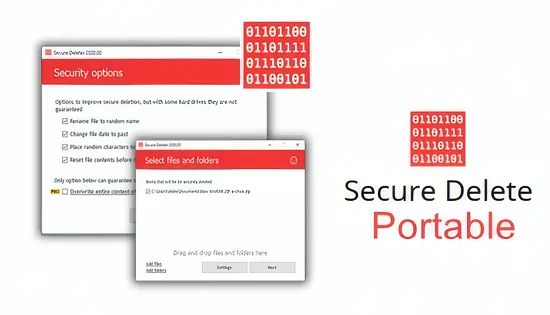
In today’s data‑driven environment, the risk of leaving behind recoverable fragments of confidential files is a serious concern for both individuals and organizations. Secure Delete Professional v221 delivers a purpose‑built solution that overwrites digital remnants, guaranteeing that deleted information cannot be resurrected by forensic tools or ordinary recovery utilities.
The utility blends a straightforward drag‑and‑drop workflow with a suite of internationally recognized erasure standards, making it suitable for casual users who need occasional privacy protection as well as enterprises that must satisfy strict regulatory audits. Its portable nature means it can be run from a USB stick on any compatible Windows machine without installation.
Irreversible Data Erasure Techniques
At the heart of the program lies a multi‑pass overwriting engine that replaces every bit of a file with random patterns, predefined characters, or zeros. By performing several passes, the software eliminates magnetic remnants on traditional hard drives, rendering data unrecoverable even with advanced magnetic imaging methods.
For solid‑state drives, the tool intelligently switches to the TRIM command instead of repeated overwrites, preserving the drive’s lifespan while still ensuring that the SSD’s internal controller discards the targeted blocks securely. This dual‑mode approach respects the physical differences between storage technologies without compromising on security.
Supported Wiping Standards and Algorithms
The application offers a menu of certified wiping protocols, allowing users to align the deletion process with corporate policies or legal mandates. Each algorithm is implemented according to its original specification, delivering the exact number of passes and data patterns required for compliance.
- DoD 5220.22‑M – 3‑pass and 7‑pass variants for U.S. government‑grade sanitization.
- Gutmann – 35‑pass method designed for legacy magnetic media.
- NIST SP 800‑88 – Modern guidelines that balance security and efficiency.
- German BSI/BSI‑TR‑03111 – European standard for high‑assurance data destruction.
Users can select a fast 1‑pass option for low‑risk data or opt for the exhaustive Gutmann routine when handling highly sensitive intellectual property. The interface clearly indicates the expected duration and security level of each method, helping administrators make informed decisions without needing deep technical knowledge.
Versatile Target Options and SSD Optimization
Beyond individual files, the utility can sanitize entire directories, whole partitions, or even the free‑space left on a drive after normal deletions. This capability is essential when preparing a laptop for resale, decommissioning a server, or simply ensuring that remnants of previously erased documents never reappear.
When an SSD is detected, the program automatically disables the multi‑pass routine and issues a secure TRIM request, which instructs the drive’s firmware to purge the selected blocks. This prevents unnecessary wear while still meeting data‑protection requirements, a balance that many legacy‑only tools fail to achieve.
Batch Operations, Logging, and Compliance
The batch processor accepts multiple files or folders at once, queuing them for simultaneous overwriting. This feature dramatically reduces the time needed for large‑scale clean‑ups, such as clearing out shared network shares or wiping archival storage before a hardware refresh.
After each run, the software generates a detailed log that records the items processed, the chosen algorithm, timestamps, and optional user comments. These reports can be exported for audit trails, helping organizations demonstrate compliance with GDPR, HIPAA, PCI‑DSS, or other data‑privacy frameworks.
User Experience and Cross‑Platform Performance
The graphical interface follows a clean, wizard‑style layout that guides users from file selection through method confirmation. Drag‑and‑drop support, contextual help bubbles, and multilingual menus lower the learning curve, while power users can disable prompts and enable command‑line parameters for automation.
Compatible with Windows XP through Windows 11 on both 32‑bit and 64‑bit architectures, the application leverages multi‑core processors to accelerate overwriting tasks. It also offers pause and cancel controls, ensuring that critical operations can be halted without leaving partially sanitized data behind.