
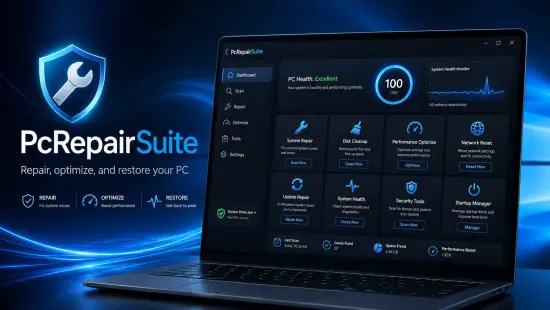
When a Windows workstation starts lagging, crashes, or refuses to boot, most users scramble for separate utilities, each promising a slice of the solution. Imagine a single, self‑contained package that can probe hardware, cleanse the OS, and rebuild a lost system—all without an internet connection. PC Repair Suite 2.1.1 delivers that experience, packaging more than twenty diagnostic and repair engines into a tidy, portable interface.
The suite is engineered for three primary audiences: home enthusiasts who want a safety net, small‑office IT staff needing a quick‑response toolbox, and field technicians who must work on machines isolated from corporate networks. Because it runs entirely from a USB stick, no installation is required, and all actions leave no trace on the host beyond the changes you explicitly approve.
Integrated Diagnostic Cockpit
Launching the program opens a modern console that resembles a mission‑control panel. Real‑time graphs track CPU and GPU loads, RAM distribution appears as a pie chart, and disk health is shown through color‑coded gauges. Critical thresholds flash red, while minor warnings stay yellow, giving an instant visual cue about what needs attention.
A single Scan button initiates a sweep across more than twenty system categories—ranging from firmware versions to network latency. The resulting report lists findings in order of severity, supplies an estimated time to fix each issue, and suggests whether a one‑click repair is safe.
Deep Hardware Stress Engine
The hardware module pulls data from WMI, ACPI, and low‑level APIs, exposing over fifty parameters such as core voltages, fan RPMs, SSD wear (TBW left), and SMART attributes for every attached drive. Users can launch stress loops that mimic Prime95 CPU burn‑ins, FurMark GPU loads, or MemTest86 memory patterns, while the suite records temperature spikes and any crashes.
For storage, the tool goes beyond Windows’ built‑in chkdsk. It performs surface scans that locate bad sectors, applies TRIM optimizations on SSDs, and validates NVMe firmware integrity. A dedicated battery analyzer charts capacity loss and cycle count, offering a recalibration routine for laptops that have drifted from their original specs.
System Restoration and Cleanup Tools
At the OS level, the suite houses a replacement for SFC/DISM that rebuilds corrupted system files directly from the local component store, eliminating the need for external media. Its registry cleaner uses a conservative heuristic to flag orphaned keys, inflated startup hives, and leftover entries from uninstalled programs. Each entry can be previewed, and dependencies are displayed before any deletion occurs.
Boot‑time performance receives a boost through a visual startup optimizer that maps services and drivers on a timeline. Users may disable non‑essential entries—such as telemetry services or legacy Cortana components—with a single click, often shaving 40‑70 % off cold boot times. The Service Manager further groups items into “essential,” “safe‑to‑disable,” and “suspicious,” protecting the system from accidental breakage.
Performance Tuning Modules
Beyond basic clean‑up, the suite offers a suite of tweaks that target memory, storage, and power consumption. Dynamic RAM compression runs in the background, freeing up 20‑30 % of memory without third‑party drivers. The disk defragmenter intelligently handles both HDDs and SSDs, placing frequently accessed files on the fastest sectors and scheduling the operation at boot for locked files.
- Process Tamer – raises priority of foreground applications while throttling background hogs.
- Power Profile Builder – creates custom schemes for gaming, battery saving, or silent operation, integrating OEM sensor data for safe undervolting.
- Network Optimizer – clears DNS caches, applies TCP tweaks, and configures QoS for low‑latency streaming.
A separate Game Booster profile temporarily disables automatic updates and antivirus scans, then expands the pagefile onto a RAM‑disk to reduce stutter during intensive sessions.
Backup & Recovery Toolbox
Data protection is addressed through a multi‑layered approach. The System Imaging feature creates bootable, sector‑level clones stored as encrypted VHDX files, supporting incremental updates to keep backup sizes manageable. A lightweight “OneKey Backup” option captures a hot image of a running OS, then verifies integrity before the user ejects the drive.
For on‑the‑fly restores, the suite can generate a standalone Windows PE environment pre‑loaded with all utilities. This USB‑based rescue system allows password resets, bootrec repairs, or driver injection on machines that refuse to start. A built‑in data‑recovery module can carve deleted NTFS partitions, presenting a preview of recoverable files before committing to write.