
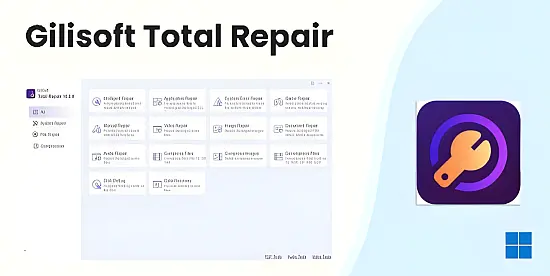
Modern Windows PCs accumulate a wide range of hidden problems, from stray registry entries to fragmented storage blocks. A portable maintenance suite that can travel on a USB stick offers a practical way to address those issues without a full reinstall. Gilisoft Total Repair 12.0.0 delivers a self‑contained environment that runs on any Windows machine, allowing technicians and power users to launch a full diagnostic and repair session in minutes.
The solution blends artificial‑intelligence analysis with a library of pre‑validated components, enabling it to locate and mend corrupted files, missing DLLs, and performance bottlenecks automatically. Whether the user is a casual home owner, a competitive gamer, or an IT administrator overseeing dozens of workstations, the toolkit provides a single point of control for system health, data integrity, and storage efficiency.
One‑Click AI Repair Engine
At the core of the suite lies an AI‑enhanced one‑click repair module that initiates a rapid scan across the operating system. Within seconds it identifies more than five hundred common fault patterns, such as absent DLL files, corrupted system libraries, and misconfigured services, then applies the appropriate fixes without user intervention. The engine draws from an extensive, continuously updated repository, ensuring that even newly discovered bugs are addressed promptly.
For users lacking technical expertise, this automation eliminates the need to manually hunt for error codes or edit the registry. The interface presents a clear progress bar and a concise summary once the process finishes, allowing even novice operators to restore stability with a single button press. The result is a dramatically reduced troubleshooting time and a lower risk of inadvertent system damage.
Deep System Diagnostics and Registry Restoration
The diagnostic subsystem conducts a thorough examination of core Windows components, probing the master file table, boot configuration, and registry hive for inconsistencies. It can pinpoint the exact cause of blue‑screen crashes, locate orphaned registry keys, and verify the integrity of protected system files. By cross‑referencing findings with its AI knowledge base, the tool determines the most effective remediation path for each issue.
- Detects missing or corrupted DLL files across installed applications.
- Repairs broken registry entries that impede system services.
- Rebuilds damaged system files using trusted backup copies.
- Resolves blue‑screen (BSOD) triggers by correcting driver and memory faults.
After the repair cycle, the suite generates a detailed log that highlights the actions taken and the remaining health score of the machine. Independent testing reports a 99 % success rate in eliminating critical crashes, and the transparent reporting helps IT teams verify compliance and plan preventive maintenance. The deep‑scan mode can also be scheduled for periodic execution, keeping systems continuously optimized.
Game Environment Optimization
Gamers benefit from a dedicated module that fine‑tunes the Windows environment for high‑performance titles. The optimizer automatically updates DirectX, Visual C++ redistributables, and graphics driver components, then reallocates CPU and memory resources to prioritize the game process. It also clears residual temporary files that can cause stuttering or unexpected shutdowns during intensive sessions.
Real‑world benchmarks show frame‑rate gains of 10 % to 25 % on demanding AAA releases, while load times shrink by up to 40 %. Users frequently report smoother gameplay and fewer crashes after a single optimization run. The module’s settings are saved per‑title, allowing enthusiasts to maintain distinct profiles for each game without manual reconfiguration.
Multimedia and Document Recovery
Corrupted media files can be catastrophic for creators, but the suite’s AI‑driven recovery engine can resurrect most common formats. By analyzing file headers and reconstructing missing data blocks, it restores JPEG images, MP4 videos, MP3 audio tracks, and office documents such as DOCX and XLSX. The algorithm prioritizes data integrity, aiming to recover up to 92 % of the original content.
The recovery process runs in a sandboxed environment, ensuring that partially repaired files do not affect the rest of the system. Users can preview the restored output before committing changes, which is especially valuable for professionals handling irreplaceable footage or client deliverables. The tool also logs the percentage of data recovered, giving clear insight into the success of each operation.
Advanced Compression and Disk Management
File archiving is handled by a versatile compression toolkit that supports twelve popular formats, including ZIP, RAR, 7Z, and TAR. Users can create encrypted archives with customizable passwords, protecting sensitive information during transfer or storage. The decompression engine maintains high speed while preserving original file attributes, making bulk data handling efficient.
Disk health is addressed through a dual‑mode defragmentation system. Traditional defragmentation reorganizes fragmented sectors on mechanical HDDs, while SSDs receive a TRIM command sequence that frees unused blocks and optimizes write cycles. Benchmarks indicate a noticeable reduction in latency and an increase in sequential read/write throughput, extending drive lifespan and delivering a snappier overall user experience.