
SketchUp Pro 2026 v26.2.243 delivers a comprehensive set of tools for creating three‑dimensional models across architecture, engineering, product design, and visual communication. Built on a mature codebase, the latest release refines performance, expands the library of components, and integrates tighter cloud workflows, making it a solid choice for professionals who need precision without a steep learning curve.
Because the application runs as a portable package, users can launch it from removable media or a network location without a traditional installation. This flexibility simplifies deployment in studios, on‑site offices, or educational labs, while still providing full access to the desktop‑grade feature set.
Intuitive User Interface
The workspace is organized around a clean toolbar and context‑sensitive panels that surface the most relevant commands as you work. Icons are large, labeled, and grouped logically, allowing newcomers to locate drawing, editing, and navigation tools within seconds. Keyboard shortcuts mirror the visual layout, so power users can keep their hands on the keyboard for rapid iteration.
Navigation is handled through orbit, pan, and zoom gestures that feel natural on both mouse and touchpad devices. The cursor changes dynamically to indicate the active mode, and real‑time feedback highlights selected geometry in a distinct blue hue, reducing the chance of accidental edits. Overall, the interface balances simplicity with depth, letting users scale from quick sketches to detailed construction documents.
Fundamental Modeling Tools
SketchUp’s core toolkit focuses on geometric primitives that can be combined, extruded, and refined to form complex structures. The line, rectangle, circle, and polygon utilities let you lay down precise edges, while the push/pull operation instantly transforms flat faces into volumetric solids. These basics are reinforced by snapping and inference guides that keep dimensions accurate without manual measurement.
- Line tool – draw straight edges or freehand strokes.
- Rectangle tool – create perfect or dimension‑driven quadrilaterals.
- Circle tool – generate arcs and full circles with radius control.
- Push/Pull tool – extrude faces into 3‑D volumes.
- Follow Me tool – sweep profiles along paths for rails or moldings.
Beyond the basics, the software offers group and component hierarchies that let you reuse geometry across a project. When a component is edited, every instance updates automatically, ensuring consistency and saving time on repetitive tasks. The combination of simple primitives and robust grouping makes SketchUp a versatile platform for everything from single‑room layouts to entire cityscapes.
Advanced Materials and Rendering
A rich material library ships with the program, featuring realistic textures for wood, metal, glass, and concrete. Users can apply these presets with a single click, or import custom bitmap maps to achieve brand‑specific finishes. The material editor supports UV scaling, bump mapping, and reflective properties, allowing designers to simulate how light interacts with surfaces.
For presentation‑grade visuals, SketchUp integrates with rendering extensions that produce photorealistic outputs. By adjusting exposure, shadows, and environment lighting, you can generate stills that convey mood and material fidelity. The workflow remains within the same file, so you avoid the overhead of exporting to external render engines unless higher fidelity is required.
2D Documentation and Layout
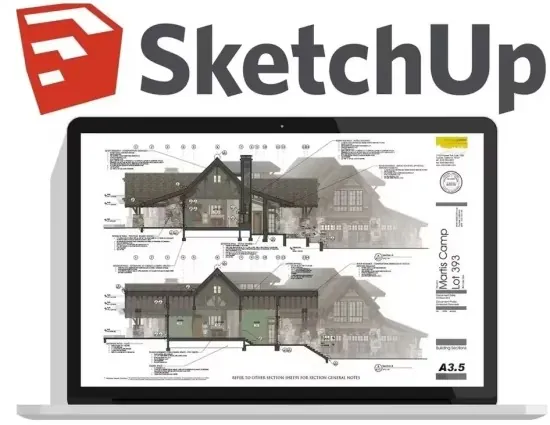
The companion LayOut application transforms 3‑D models into scaled 2‑D drawing sets, complete with dimensions, callouts, and annotation tools. Users can create floor plans, elevations, and sections that automatically update when the underlying model changes, ensuring that documentation stays synchronized throughout the design process.
Styles and templates let you enforce corporate branding across all sheets. Title blocks, legends, and revision clouds are readily available, and the vector‑based output ensures crisp prints at any scale. This seamless bridge between 3‑D modeling and 2‑D drafting streamlines the hand‑off to contractors and consultants.
Collaboration, Cloud Storage, and VR
SketchUp Pro 2026 leverages Trimble Connect for cloud‑based project sharing. Models can be uploaded, versioned, and accessed by team members from any browser, facilitating real‑time feedback and reducing email‑driven file exchanges. Permissions can be set to control who can view, edit, or comment on a design.
The suite also supports immersive visualization through VR headsets such as Microsoft HoloLens, HTC Vive, and Oculus devices. By exporting a model to a VR scene, stakeholders can walk through a virtual prototype, gaining spatial insight that static renders cannot provide. This combination of cloud collaboration and immersive review helps align expectations early and accelerates decision‑making.