
Imagine taking an old family camcorder clip or a low‑budget YouTube vlog and turning it into a crisp, cinema‑grade sequence without spending hours in a full‑blown editor. Nero AI Video Upscaler Pro 1.3.20.0 makes that scenario a reality by applying deep‑learning inference to every frame, reconstructing missing detail and smoothing motion in a single, portable package.
The tool is built for Windows power users who need high‑quality results quickly—whether you are restoring archival footage, preparing 4K deliverables for a channel, or simply polishing personal videos before sharing them online. Its one‑click workflow, combined with batch handling, removes the steep learning curve traditionally associated with AI‑based upscaling.
Why AI Upscaling Matters for Modern Video
Conventional upscaling algorithms, such as bicubic or Lanczos, merely stretch pixels, which often leads to blurry edges and blocky artifacts. Nero’s proprietary super‑resolution engine analyses each pixel in context, predicts the most plausible high‑frequency information, and inserts it back into the frame. The result is a perceptual boost that can turn a 720p clip into a genuine 4K—or even an 8K—experience with natural texture recreation.
Beyond spatial resolution, the application also offers AI‑driven frame interpolation. By estimating optical flow between existing frames, it can generate intermediate images, raising the frame rate from the typical 24/30 fps up to 120 fps. This creates buttery‑smooth slow‑motion or high‑speed playback without the ghosting seen in older interpolation plugins.
Specialized Neural Models and Their Ideal Use‑Cases
The software ships with six purpose‑tuned models, each trained on millions of video pairs to excel in a particular domain. Selecting the correct model is as simple as picking an option from a dropdown, yet the impact on the final output is noticeable.
- Realistic Model – Optimized for live‑action footage; maintains natural skin tones and realistic lighting.
- Versatile Model – A balanced choice for mixed content such as interviews or product demos.
- Animation Model – Preserves crisp edges and vibrant palettes in cartoons, anime, or CGI renders.
- Fast Model – Prioritizes speed, ideal for large libraries where 2×‑4× upscales are sufficient.
- Face Enhancement Model – Isolates human faces, sharpening eyes and smoothing blemishes for close‑ups.
- Custom Blend – Allows users to combine model weights for hybrid results, e.g., Realistic base with Face overlay.
These models can be chained or fine‑tuned, giving professionals the flexibility to adapt the AI to unique visual styles without leaving the application.
Hardware Demands and Supported Formats
Nero AI Video Upscaler Pro relies heavily on GPU acceleration. It supports NVIDIA CUDA, AMD Radeon, and Intel Arc GPUs, delivering conversion times measured in minutes for 1080p‑to‑4K jobs on a mid‑range RTX 3060. When a compatible GPU is unavailable, the engine falls back to a multi‑threaded CPU path, though processing speed drops noticeably.
The program accepts virtually any container: MP4, MOV, AVI, MKV, WMV, FLV, WebM, as well as professional codecs like ProRes and DNxHR. Output can be encoded to H.264, H.265/HEVC, or lossless intermediates, with optional alpha‑channel preservation for compositing workflows.
Streamlined Interface and Batch Automation
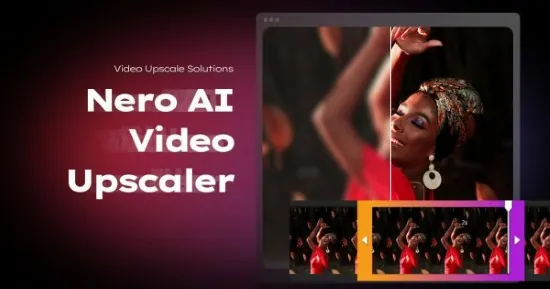
A dark‑themed window greets users with a drag‑and‑drop zone and a split‑screen preview that toggles between original and AI‑enhanced frames. Controls for model selection, upscale factor, and interpolation strength sit on the right, while a playhead lets you scrub through the clip to inspect motion quality in real time.
Batch processing is built into the queue manager. Users can add unlimited clips, prioritize by file size or type, and pause or resume jobs at will. The software also monitors a watch folder, automatically launching the chosen pipeline whenever new media appear—perfect for hands‑free archival projects.
For those who need to share results quickly, preset export profiles for YouTube, TikTok, and other platforms are included, ensuring the correct bitrate and resolution without manual tweaking.
Performance Benchmarks and Practical Tips
In independent tests, a 30‑minute 1080p documentary processed with the Realistic Model and 4× upscaling reached 8K output in under 45 minutes on an RTX 4090, while the Fast Model completed the same job in roughly 12 minutes with a modest quality trade‑off. Memory usage stays below 8 GB for most tasks, making the tool viable on high‑end laptops.
A few best‑practice recommendations help you squeeze the most out of the engine: use the built‑in proxy preview to set parameters on a low‑resolution sample before committing to the full render; enable adaptive temporal denoising only when the source exhibits noticeable grain; and reserve the Face Enhancement Model for close‑up shots rather than wide‑angle scenes to avoid over‑sharpening background elements.
When working with legacy interlaced material, enable the de‑interlacing option; the AI will double vertical resolution while eliminating combing artifacts. Finally, keep your GPU drivers current—new driver releases often include performance patches that accelerate the underlying CUDA kernels.