
SketchUp Pro 2026 delivers a robust set of tools for creating three‑dimensional models across architecture, engineering, and product design. Built on a decades‑long legacy, the latest release refines the balance between power and accessibility, allowing professionals and hobbyists alike to translate ideas into precise geometry without a steep learning curve. The application runs natively on Windows, leveraging modern hardware to render complex scenes in real time while maintaining a lightweight footprint.
Beyond its visual appeal, the software integrates tightly with a cloud‑based ecosystem that supports version control, sharing, and collaborative review. Whether you are drafting a conceptual sketch or finalizing construction documents, the suite provides a seamless workflow from initial concept to client presentation, reducing the need for multiple disjointed programs.
User‑Friendly Interface and Navigation
The workspace is organized around a minimalist toolbar that places the most frequently used commands within immediate reach. Icons are clearly labeled, and contextual menus appear only when needed, preventing visual clutter. Users can toggle between orthographic and perspective views with a single click, while pan, orbit, and zoom gestures respond intuitively to mouse or touch inputs, making model manipulation feel natural.
Customization options let you rearrange panels, store favorite toolsets, and assign keyboard shortcuts to match personal habits. Quick access palettes can be docked or floated, enabling a tailored environment that speeds up repetitive tasks. The interface also supports high‑DPI displays, ensuring crisp icons and legible text on modern monitors.
Core Modeling Tools and Advanced Capabilities
At its core, SketchUp Pro provides a suite of geometric primitives—lines, rectangles, circles, and polygons—that serve as the building blocks for any model. These primitives can be extruded, rotated, or scaled using the Push/Pull, Rotate, and Scale tools, allowing rapid creation of complex forms from simple shapes. The software also includes a robust set of inference mechanisms that snap to edges, midpoints, and angles, ensuring precision without manual measurement.
Advanced users benefit from features such as surface modeling, solid creation, and dynamic components. Surface tools enable smooth lofting and curvature control, while solid operations—union, subtract, intersect—facilitate Boolean workflows. Dynamic components introduce parametric behavior, letting a single model adapt its dimensions or appearance based on user‑defined variables, which is especially useful for product families and modular architecture.
Materials, Textures, and Customization Options
The material library offers a broad spectrum of pre‑configured finishes, from concrete and glass to wood grain and metal sheens. Users can apply these textures with a single click, instantly visualizing how surfaces will appear under realistic lighting. For projects that demand a unique look, the editor supports custom bitmap imports, allowing you to create bespoke patterns or replicate specific brand colors.
- Adjust reflectivity, bump mapping, and opacity for each material.
- Organize assets into user‑defined libraries for quick reuse.
- Apply procedural textures that adapt to surface curvature.
- Save and share custom material sets across team members.
Beyond visual styling, the software integrates a powerful shading engine that simulates sunlight, artificial lighting, and environmental reflections. Real‑time rendering updates as you modify geometry or material properties, providing immediate feedback on design decisions. This level of visual fidelity helps stakeholders evaluate aesthetics early in the process, reducing costly revisions later.
Documentation, Layout, and Presentation Features
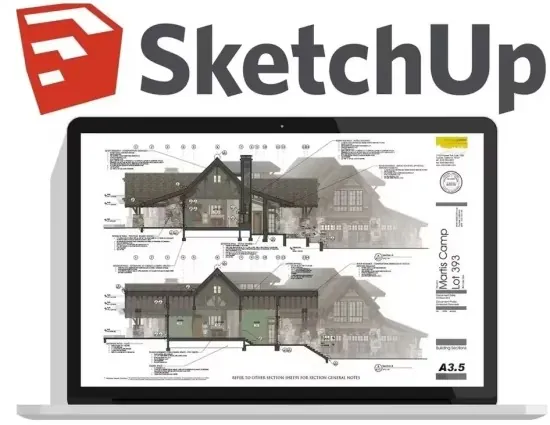
SketchUp Pro includes a dedicated 2D documentation module that transforms 3D models into scaled drawing sets. Users can generate floor plans, elevations, and sections with precise dimensions, automatically linked to the underlying geometry. Annotations such as text labels, leader lines, and dimension markers can be placed directly on the layout, ensuring that every detail is clearly communicated.
The layout environment supports multiple page sizes, custom title blocks, and vector‑based export options for PDF or DWG files. By maintaining a live connection to the 3D model, any change made in the modeling space instantly updates the corresponding drawings, preserving consistency across design iterations and simplifying the coordination process with consultants.
Collaboration, Cloud Integration, and Extensibility
A built‑in cloud service enables seamless sharing of models and project files among team members. Projects can be stored in a secure online repository, granting controlled access to collaborators who can view, comment, or edit in real time. Version history tracks every modification, allowing users to revert to earlier states if needed.
The platform also supports a rich ecosystem of extensions through a dedicated marketplace. Developers can add specialized tools—such as structural analysis, energy modeling, or custom export formats—extending the core functionality to suit niche workflows. This extensibility ensures that SketchUp Pro remains adaptable to evolving industry standards and project requirements.