
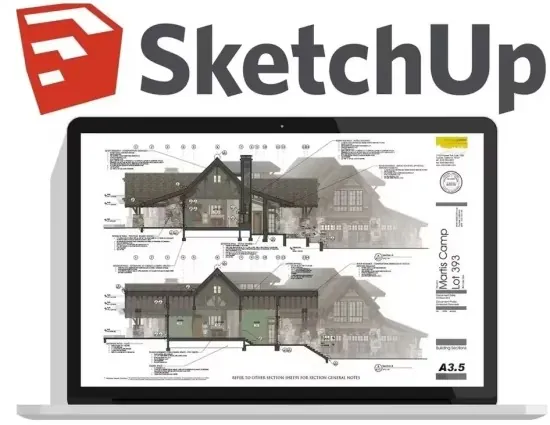
SketchUp Pro 2026 delivers a comprehensive environment for constructing three‑dimensional models across a wide range of disciplines. Architects can draft building envelopes, engineers can visualize mechanical assemblies, and graphic designers can prototype product concepts, all within a single application. The platform balances precision with speed, allowing users to generate complex geometry without sacrificing performance. By supporting both metric and imperial units, it adapts to regional standards, while its real‑time rendering engine provides immediate visual feedback. This combination makes the software a go‑to solution for professionals seeking a versatile modeling toolkit.
Since its inception, SketchUp has evolved from a lightweight drafting tool into a full‑featured design suite, and the 2026 release continues that trajectory. Integrated cloud services enable seamless project storage and version control, reducing the need for external file‑sharing solutions. The software also introduces enhanced interoperability with popular BIM and CAD formats, simplifying data exchange between disciplines. A refreshed toolbar layout and customizable shortcuts streamline workflow, while the inclusion of a modernized rendering engine elevates visual fidelity. Together, these improvements position the platform as a future‑ready solution for collaborative design environments.
User‑Friendly Interface and Navigation
Navigating SketchUp Pro 2026 feels intuitive thanks to its clean, ribbon‑style toolbar and context‑sensitive panels. Frequently used commands such as Select, Move, and Push/Pull sit prominently, reducing mouse travel for seasoned users. New users benefit from tooltips that appear on hover, offering concise explanations without interrupting the modeling process. The workspace can be partitioned into multiple tabs, allowing designers to keep separate projects organized within a single session. Additionally, the program supports high‑DPI displays, ensuring crisp icons and legible text on modern monitors.
Beyond the primary toolbar, the software provides a customizable shortcut bar where users can pin their preferred functions for instant access. Keyboard shortcuts are fully editable, enabling teams to align the interface with established standards. The navigation cube in the viewport offers rapid orientation changes, while mouse scroll and pan gestures deliver fluid camera control. A built‑in help center, searchable from within the application, supplies step‑by‑step guides and video tutorials. This blend of discoverability and personalization accelerates the learning curve for newcomers and power users alike.
Core Modeling Tools and Advanced Capabilities
At the heart of SketchUp’s modeling capabilities lies a robust set of geometric primitives. Simple entities such as lines, rectangles, circles, and polygons can be drawn with pixel‑precise accuracy, forming the foundation for more elaborate structures. The Push/Pull command transforms these 2D outlines into volumetric forms with a single drag, while the Follow Me tool extrudes profiles along defined paths. For complex assemblies, the software offers solid modeling functions, including boolean operations that merge or subtract volumes. These tools collectively enable rapid iteration from concept to detailed design.
Advanced users can exploit surface modeling features to refine curvature and create organic shapes that would otherwise require extensive manual editing. The program supports edge smoothing, softening, and the application of custom profiles to edges, granting fine control over visual appearance. Dynamic Components introduce parametric behavior, allowing objects to adapt size, material, or configuration based on user input. Integrated rendering plugins further enhance realism by simulating lighting, shadows, and reflections. Together, these capabilities empower professionals to produce high‑quality, production‑ready models without resorting to external applications.
Material Library and Custom Texturing
The built‑in material library supplies a broad spectrum of textures, ranging from natural finishes to manufactured surfaces. Users can quickly apply wood grain, concrete, metal, or glass to any face, instantly visualizing the impact on the model’s aesthetic. Each material includes adjustable parameters such as reflectivity, bump mapping, and opacity, enabling nuanced control over how light interacts with the surface. The library is organized into categories for rapid browsing, and a search function filters results by keyword. This ready‑made collection accelerates the styling phase of any project.
- Wood finishes with grain and varnish options
- Metallic surfaces featuring brushed and polished looks
- Concrete and masonry textures for structural realism
- Glass and transparent materials with adjustable refraction
- Fabric and upholstery patterns for interior design
In addition to the pre‑packaged assets, SketchUp Pro 2026 permits users to create custom materials from image files or procedural generators. By importing high‑resolution photographs, designers can replicate specific brand colors or unique surface treatments. The material editor lets users fine‑tune UV mapping, scale, and rotation to ensure seamless coverage on complex geometry. Coupled with Dynamic Components, custom textures can respond to parameter changes, such as switching between matte and glossy finishes on the fly. This flexibility ensures that every model can achieve a truly bespoke appearance.
Documentation, Layout, and Presentation Features
Beyond three‑dimensional modeling, SketchUp integrates a dedicated 2D documentation suite that streamlines the production of construction drawings. The LayOut application imports model views, allowing users to arrange orthographic projections, sections, and exploded diagrams on sheet templates. Scale bars, dimension lines, and annotation tools add precise measurements and explanatory notes directly onto the drawings. Templates adhere to industry standards, and users can customize title blocks to reflect project branding. This seamless bridge between 3D and 2D ensures consistency throughout the design workflow.
Annotation capabilities extend to rich text formatting, leader lines, and symbol libraries, facilitating clear communication with contractors and stakeholders. Export options include PDF, DWG, and high‑resolution image formats, enabling easy distribution across various platforms. The software also supports batch publishing, allowing multiple sheets to be generated from a single model with minimal effort. By consolidating modeling, documentation, and presentation within one ecosystem, SketchUp reduces the reliance on disparate tools and minimizes potential data loss during handoffs.
Collaboration, Cloud Integration, and Extensibility
Collaboration lies at the core of the 2026 release, with built‑in cloud connectivity powered by Trimble Connect. Projects can be stored securely online, granting team members instant access from any device with appropriate permissions. Real‑time co‑editing lets multiple users manipulate the same model simultaneously, while version history tracks changes and facilitates rollback when needed. Integrated comment threads and markup tools streamline feedback cycles, ensuring that design intent remains transparent throughout the development process.
The platform’s extensibility is further enhanced by a vibrant ecosystem of plugins and Ruby scripts, which can be installed directly from the Extension Warehouse. These add‑ons introduce specialized functions such as energy analysis, terrain modeling, and advanced rendering. API access enables developers to craft custom workflows that integrate with enterprise resource planning or project management systems. By combining native collaboration features with a flexible extension framework, SketchUp Pro 2026 positions itself as a scalable solution for both small studios and large multidisciplinary firms.